
Published 16/03/2026 | Last Updated 16/03/2026
In this blog post, Owen, who joined Trydan recently, unpacks his first visit to a wind farm on the Woodland Estate, reflecting upon the lessons he learned and the experiences and conversations which foiled his preconceptions.
Find out more about Owen’s work, as part of our early careers workforce at Trydan, here.
-
The thought of an employee working at a renewable energy developer is likely to ignite a typical image in the imagination: shiny white hat, hi-vis jacket with the company logo as a neon beacon at its centre, a clipboard in-hand and a finger often pointing at various points in the distance. However, this is not the average day expected by an employee in Liaison and Communications, a department usually working in less remote locations.
That is why, after joining Trydan in late 2025, I was very eager to visit the sites of our proposed projects. My curiosity regarding the nature of the relationship between large energy generation systems and an active forest – which is, in essence, the relationship between modern humanity’s needs and the needs of nature and habitats – drove me to prioritise the in-person visit.
And so it was in January that I took advantage of a site visit by Adam, Project Manager for Trydan’s planned Clocaenog Dau Wind Farm, to Clocaenog Forest with Natural Resources Wales (NRW), who manage the woodland.
Before I had even arrived at our meeting point within the forest, I was struck by the sights of the site. All of a sudden, whilst I drove across the hills near Cerrigydrudion and Llanfihangel Glyn Myfyr, there appeared giant dancers of shining white amidst the trees. What a sight! Though I’d seen many wind turbines in the distance from my childhood home in Montgomeryshire and have learned about Trydan’s mission and plans over the last few months, nothing compared to seeing such marvels of engineering up close and in-person.
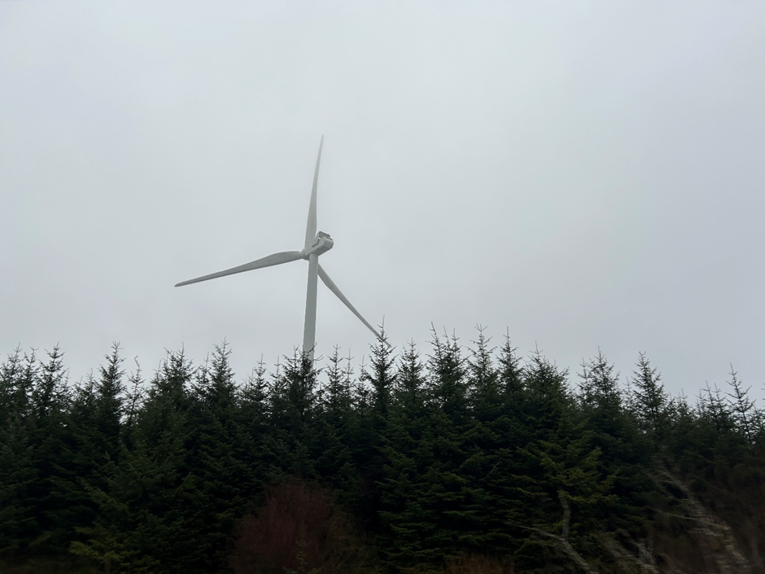
This is where my first preconception about wind farms in the woods was torn down: despite their grand size, woodland became the most fitting setting in which I had ever seen a wind turbine. Of course, the shape of the landscape helps to blend the two elements, as turbine height statistics are softened to an extent by the uneven nature of the land. Beyond that, the symbolism of them both – the turbines’ clean, renewable energy, and the forest’s action as the oxygenating lungs of the environment – suited one another in a hopeful manner. Considering Trydan’s principles, as a publicly owned company that will retain the power and benefits of the energy transition with the Welsh people, this hope will only grow!
As I met and travelled through the forest with the NRW team, other preconceptions of mine were challenged. This information pack by Regen, an independent adviser for renewable energy transitions in the UK, provided a fantastic foundation for me before the visit, as a beginner in the onshore renewable energy sector.
I was welcomed warmly at our meeting place by Adam (and his loyal dog, Pepper), as well as Ffion, Clocaenog Dau’s NRW Project Manager, and Danny and Rob, NRW civil engineering advisors specialising in forestry. The team’s specialism and experience really benefitted my visit, as someone who, though passionate about the environment and the future of Wales’s communities, is a relative newcomer to the world of work and the thought processes behind large energy projects.
As we began through the forest, another preconception was challenged: I wished to see to what extent the forest was ‘natural’ in terms of the absence of human infrastructure and activity. The challenge to the idea of an untouched habitat came with the screeches of chainsaws and vehicles that we often heard, the almost-too-perfect straightness of the Sitka Spruce trees that made up most of the forest, and the network of underground cables which followed the roads we drove upon through the woods. Truly, the forest is largely a managed industry, as it has been since it was cut for timber during the First World War and replanted between the 1930s and 1950s.
Of course, the forest is not only an industry: there are important habitats within the forest, safeguarded by NRW management and work by conservation groups such as the Clocaenog Red Squirrels Trust. Danny explained some forestry techniques used at Clocaenog, as we travelled past their varied results: ‘clear-felling’, which maximises commercial value but leaves a designated area without any tree coverage; and ‘Low Impact Silvicultural System (LISS) management’, which prioritises the forest’s ecology and the appearance of the forest by staggering the thinning of forest blocks so that trees mature for felling at different times, ensuring continuous healthy tree coverage.
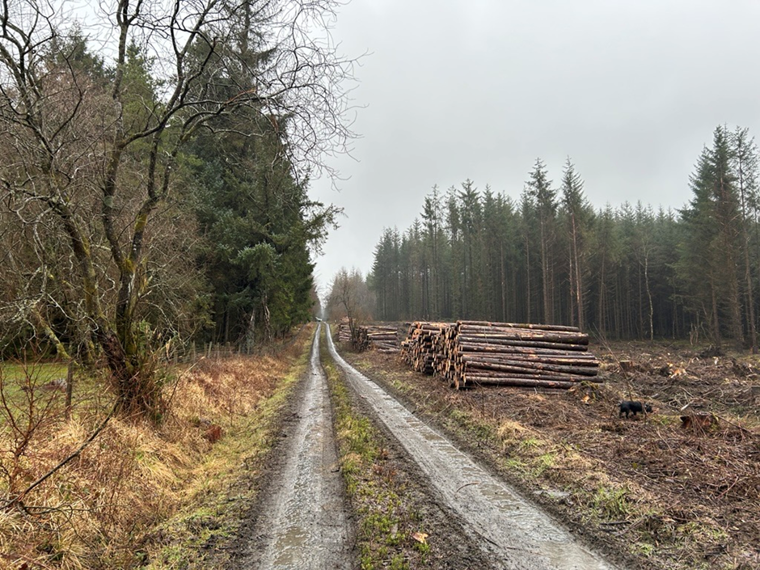
Also explained to me were the ‘cable corridors’ alongside roads throughout the forest, which have potential for creating new habitats on the ground above the underground cables which connect the current wind farm’s turbines to the substation towards the north of the forest. Up to 30m of trees are cleared where underground cables are laid, to avoid any damage to the cables – though this initially sounded like habitat loss to me, Adam explained Trydan’s plans to optimise these areas as heathland corridors, boosting the important habitat’s resilience in the area and avoiding more costly and less habitat-boosting mown grass. Heathland is fantastic for attracting invertebrates like butterflies, moths, and beetles, as well as small mammals like mice and voles – in turn, these make heathland fruitful feeding areas for bats, owls, and other raptors such as goshawk. This unexpected opportunity for ecological benefit, brought about by our modern energy needs, surprised me – I wonder what other benefits we can nurture through these projects?
Understanding these kinds of environmental processes and needs is vital to Trydan’s work, which must minimise impact upon, or even improve, the forest’s habitats as we design, construct, maintain, and decommission our projects.
-
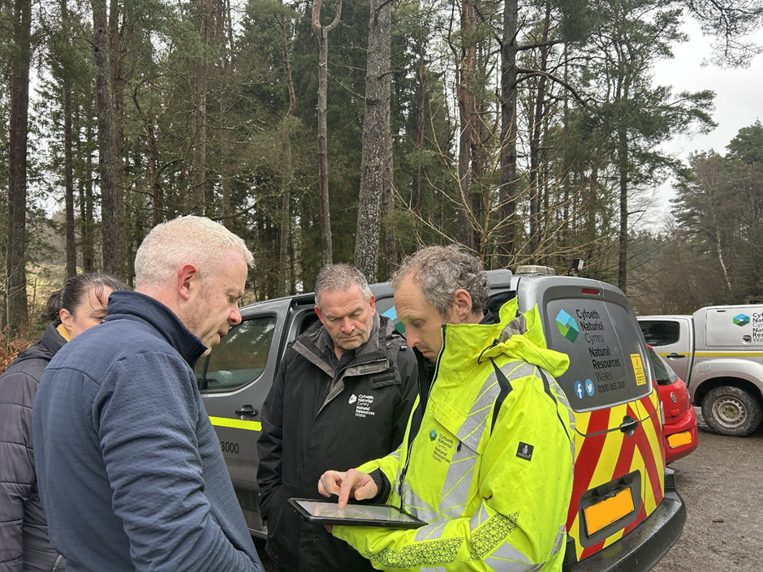
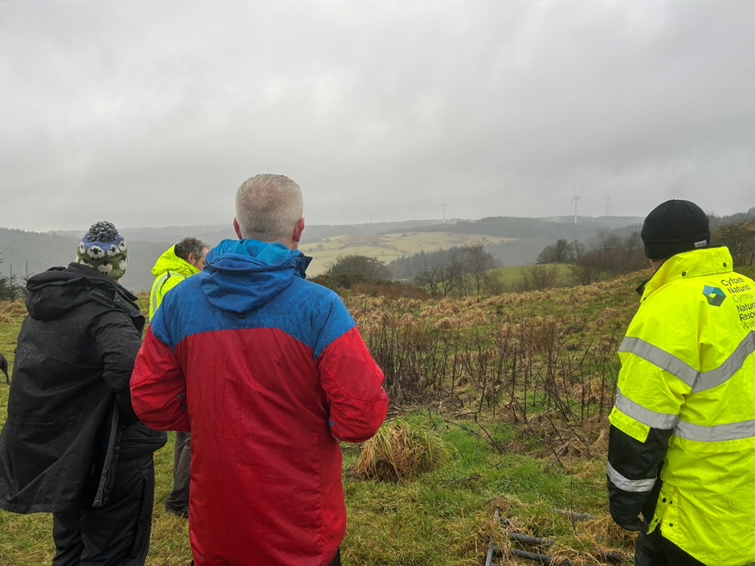
The main purpose of our journey was to finalise a location for Trydan to install a LiDAR device, which will use lasers to allow the company to begin recording wind speed and wind direction at Clocaenog. I learned a great deal about the value of this technology for understanding the environmental state of the area, and how our project could affect this. Here was another challenge to a preconception! I wanted to see how thorough the development teams were in thinking about concerns and priorities of local people regarding elements of the project: were targets and planning milestones taking priority, or the suitability of the project plans with the environment and with local communities, who are rightly eager to ensure their concerns about large energy project like Clocaenog Dau are heard?
The background and previous experience of the team is relieving: Adam was an Ecologist covering Clocaenog Forest before his current role at Trydan; Rob was previously a specialist in Flood Defence at NRW; Ffion has extensive experience in NRW’s education department; and Danny has years of experience in managing infrastructure with North Wales’s woodlands, including working during construction of the first wind farm in Clocaenog Forest, owned by RWE. Together, the team excellently combines specialism with technology, communities, and environmental responsibility. Danny emphasised the value of such a wide range of experience within the team for considering many perspectives and making the project considerate and responsible in every area of its work. Indeed, Trydan has ensured co-operation with teams which have appropriate and local expertise that ensures that considerations are tailored to each of its projects.
After having visited proposed sites for some of Trydan’s turbines, a few minutes were spared for me to experience being right beside a wind turbine within the forest! Here was my final preconception about the visit: what noise do the turbines make? I have heard concerns about visual and audible elements of wind turbines in the past, so I thought it important to get personal experience of these elements. Of course, weather, wind speed, landscape, and other aspects affect the sound of wind turbines – I am learning more about this as our projects install noise monitoring devices to understand in detail the current and potential noise levels, should our projects proceed as they are currently designed.
However, I am pleased to say that I was astonished by the giant white dancers once again, this time for their quietness on that day. Adam explained that wind energy technology has developed greatly over the last few years and decades, and that noise reduction has been a big part of these developments, as well as improvements in energy generation efficiency. The area around Clocaenog forest is a fascinating way of observing and hearing these changes, from the Tir Mostyn wind farm (built in 2005) on the borders of the forest to the Clocaenog wind farm (completed by RWE in 2020) within the woodland itself.
-
And so, my very first site visit came to an end. The day provided a valuable in-person insight into one of Trydan’s projects – a project that is already demonstrating its complexity and environmental, technical, and societal variety. But, among these complexities are the seeds of many of its answers:
1. Widely experienced team which will ensure:
- Balance of the forest’s environment as a habitat, industry and leisure area
- Adaptation, protection, and even improvement of the forest during the lifetime of large energy projects
2. Innovative technologies constantly improving and offering benefits to Wales’s energy system and economy
3. A Welsh, publicly owned company which is ready to work with Wales’s people, organisations and companies to deliver renewable energy projects which:
- Build the resilience of our domestic energy system
- Include and centre the public, as the company’s true shareholders
- Re-invest profits into the priorities of local communities and the wider nation.
As I work to engage with stakeholders local to our projects, and with people across Wales, I hope that my optimism shall spread as the impact of our work – as a public property and resource which benefits Wales and its future generations – becomes clear.