
Published 12/06/2026 | Last Updated 12/06/2026
This week (ending 12/06) Adam Dempsey project manager for Trydan Gwyrdd Cymru attended the annual International Union for Conservation of Nature (IUCN) Peatland Programme Conference, 2026 along with 400 UK and international delegates. The conference subtitle: “Peatlands Under Pressure” reflects the current pressures on peatlands and the evolving techniques of peatland survey and restoration. Adam’s focus was to join experts, from conservation organisations, statutory bodies including Cyfoeth Naturiol Cymru – Natural Resources Wales, Natural England, Forestry England, as well as commercial wind farm developers, to explore challenges, and the evolving best practice in peatland protection.
Research published by the Senedd in 2023 suggests 90,000ha or 4% of Wales’s total land area is peatland.[1] Concerning is that “about 90%” of peatland in Wales is in poor condition (NRW, 2023) mainly due to historic drainage, cutting, overgrazing and pollution.[2]
Peatland restoration is an evolving science, and encouragingly, there are multiple examples of restoring pressured peatlands in Wales. Adam joined a site visit to Crymlyn Bog National Nature Reserve as part of the conference programme (see photos). It is the largest lowland fen in Wales and highlights what can be achieved on extremely pressured sites. Today it is a fantastic peatland site with very diverse flora and fauna that is thriving despite multiple pressures, including adjacent landfill and petroleum plant, and historic drainage.
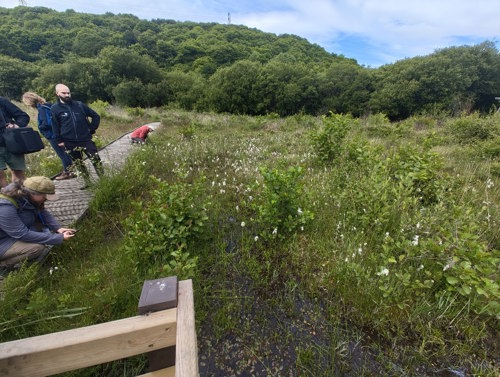
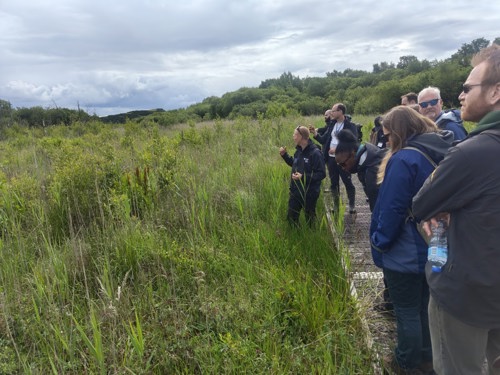
Adam says: “My key take-aways from the event, are 1) hydrology is the most important consideration when thinking about peatland restoration. 2) Peatland restoration takes a long time and needs financial commitment for multiple decades to achieve success. 3) We are restoring peatland now that 20 years ago, wouldn’t have been possible. In another 20 years, as techniques evolve, our ability to protect peat resources successfully will only grow.”
So, in terms of Trydan projects, the key factor is to plan for the long term, not just the short term. This is also a central principle of the Sustainable Management of Natural Resources (SMNR) approach we apply to our developments. Of course, as onshore wind farms are operational for around 35 years, they lend themselves particularly well to this approach – land management that supercharges multiple benefits over decades”
“I met a number of specialists and experts who can provide advice on best practice, and I will use the knowledge gained at the conference to further embed SMNR across all Trydan projects.”
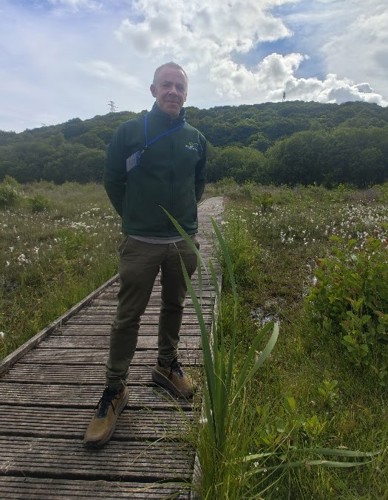
Adam Dempsey is Project Manager for the Clocaenog Dau project. He is an Environmental Specialist with more than 15 years’ experience working with conservation bodies and on the application of environmental regulations and management of wind farms for Natural England, Natural Resources Wales, and Trydan Gwyrdd Cymru.
[1] Senedd Research, ‘The importance of peatlands and their protection in Wales’, 13 December 2023 https://research.senedd.wales/research-articles/the-importance-of-peatlands-and-their-protection-in-wales/
[2] Natural Resources Wales, ‘Wales Peatland Action through the National Peatland Action Programme 2025-2030’, https://cdn.cyfoethnaturiol.cymru/av3hhxjt/npap-5-year-plan-v7-eng.pdf#:~:text=Sadly%2C%20today%20in%20Wales%20around,releases%20carbon%2C%20degrades%20water%20quality%2C